
 $ USD
$ USD


Reading Matthew 24 and 25 together completely changed the way I saw these parables. They are not random teachings that happen to sit beside one another. Jesus is sitting privately with His disciples on the Mount of Olives, answering their questions about His return and the end of the age. He has spoken about what is coming, warned them not to be deceived and told them repeatedly that nobody knows the exact day or hour.
And then His message becomes very simple: Be ready.
But what really stood out to me is what Jesus means by readiness. He does not follow His teaching about the end times with instructions to spend our lives trying to calculate dates, decode every event or work out exactly how close we are. He is not trying to make us clever or hand us a code to crack. Instead, He tells stories about how we are living when He comes back.
The faithful servant
First comes the faithful servant (Matthew 24:45–51). The master goes away and appears to be delayed. The faithful servant does not use the delay as an excuse to become careless. He simply carries on doing what his master entrusted him to do. When the master unexpectedly returns, he finds him faithfully at work.
The ten virgins
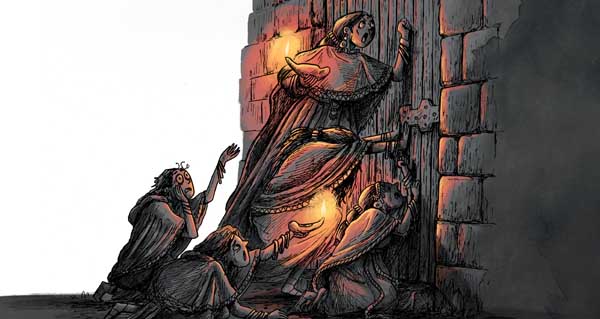
Then Jesus tells the story of the ten virgins (25:1–13). They are all waiting for the bridegroom. They all have lamps. They all become tired and fall asleep. The difference is that five have oil and five do not. When the cry suddenly comes that the bridegroom is arriving, there is no longer time to prepare. The wise virgins already have what they need. The foolish ones cannot borrow somebody else’s oil at the last minute.
That is sobering.
Whatever the oil represents in all its fullness, there is clearly something here that cannot simply be borrowed from somebody else’s relationship with God when Jesus comes. We cannot borrow somebody else’s faithfulness. We cannot borrow somebody else’s prayer life. We cannot borrow somebody else’s obedience, love for God or life with the Holy Spirit. These are things that have to be ours. Perhaps that is why the bridegroom’s words to the foolish virgins are so piercing: ‘I do not know you’ (25:12). Readiness, at its heart, is about relationship.
And that made me understand readiness very differently. It is not frantic watching. It is not fear. It is not trying to predict the date of His return. It is having oil in the lamp before the cry comes.
The talents
Then Jesus immediately tells the parable of the talents (25:14–30). Again, a master goes away and returns later. Again, there is a period of waiting. And again, the question is what his servants have done while he was gone.
The faithful servants have taken what they were entrusted with and used it. They have not simply waited passively for their master to return. They have been faithful with what he placed in their hands. The servant who buried what he was given is different. He preserved it, but he did nothing with it.
And notice why: he was afraid, because he saw his master as a hard man (25:24–25). Fear made him bury what he had been given. Knowing the true heart of our Master frees us to use what He has placed in our hands.
These parables begin to feel like one message:
Stay faithful while I am away. Keep your oil. Use what I have given you. Be ready when I return.
The sheep and the goats
Then Matthew 25 ends with the sheep and the goats (25:31–46), and again Jesus brings everything down to the reality of how people actually lived. Feeding the hungry, welcoming the stranger, clothing those in need, caring for the sick and visiting the prisoner are treated as things done to Him.
So being ready for Jesus’ return is not abstract or theoretical. It shows itself in faithfulness. It shows itself in what we do with what He has entrusted to us. It shows itself in love. It shows itself in how we treat people. None of this is about earning our place with Him. It is the fruit of a life that truly knows Him. And perhaps that is why Jesus gives these teachings immediately after the disciples ask Him about the end.
How will He find us?
We can become fascinated by when Jesus is coming back. Jesus seems far more concerned with how He will find us when He does.
- Will He find us faithfully doing what He asked us to do?
- Will there be oil in our lamps?
- Will we have used what He entrusted to us rather than burying it?
- Will our lives show His love in the way we have treated others?
Because the consistent message running through Matthew 24 and 25 is not ‘Work out the date.’
It is: Stay awake. Stay faithful. Be ready.
The Master may appear to delay. The Bridegroom may come later than expected. But He is coming. When He does, there will no longer be time to become the person we intended to become one day.
The time to follow Him is now. The time to use what He has given us is now. The time to keep our lamps burning is now.
And perhaps that is the whole point of readiness: to live today in such a way that whenever Jesus comes, He finds us already living for Him.
Come back to Him
So please do not just read this and move on. If your lamp is running low, that matters. If you have buried what God put in your hands, that matters too. The foolish virgins did not run out of oil at midnight. They had been neglecting it long before the cry came.
But here is the hope: the door is not shut yet. And the answer is not to try harder or look busier. Remember what the foolish virgins heard: ‘I do not know you.’
So come back to Him. Spend time with Him. Listen to Him. Be honest with Him. Let Him in. That is where the oil comes from.
Do not wait for the cry. Come back to Him today, and be ready. Time is short.